Designing My Days


As a programmer who juggles multiple projects at work, spanning web development, mobile apps, and AI. I also maintain open-source projects and have created cool apps like CodeFrame . Beyond coding, I dive into mathematics and philosophy, regularly share my learning on this site, and enjoy gaming in my spare time.
With so many interests pulling me in different directions, “designing” my days used to be quite the challenge. But after years of experimentation and self-reflection, I’ve discovered approaches that actually work for me.
Clarity
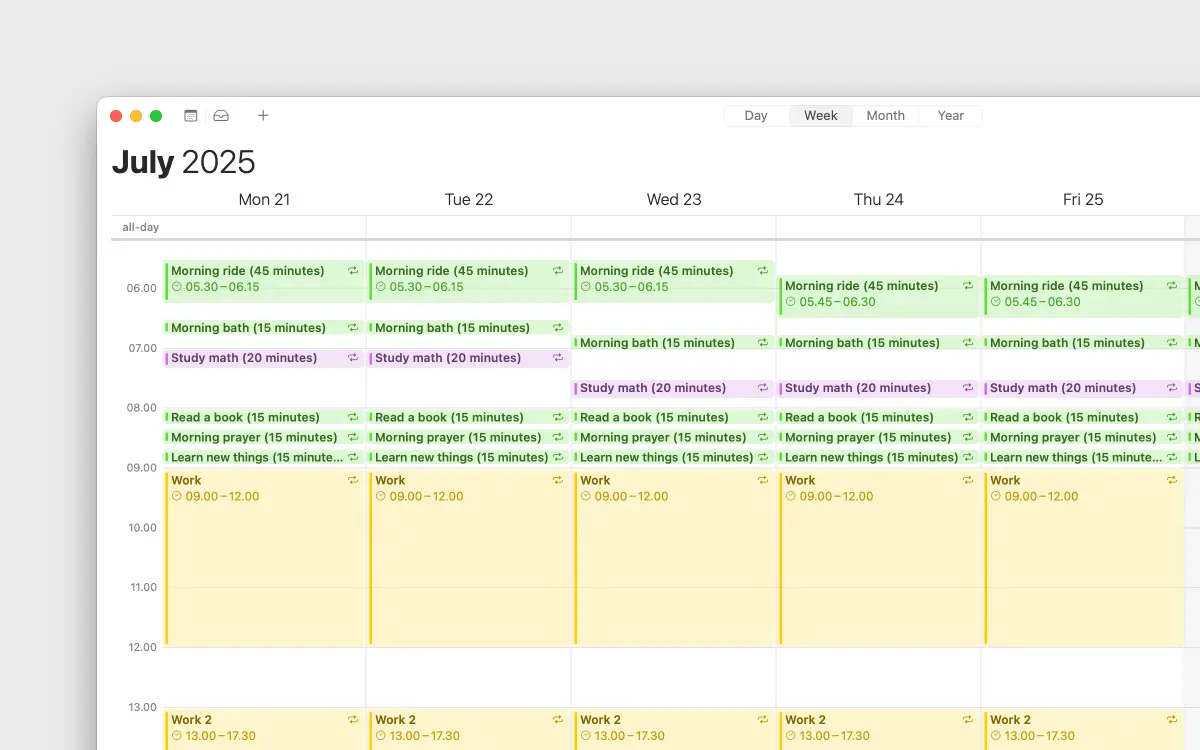
I’m the kind of person who likes clear structure, especially when starting my day. I don’t like beginning without having my activities or tasks planned out. I always block time on my calendar and set reminders for each activity, noting what, when, and where.
By knowing what I’m doing, I don’t have to waste mental energy deciding in the moment. By knowing when and where, I can prepare at least 5 minutes beforehand (which is when I usually set my reminders to go off).
This approach keeps me content throughout the day because I know exactly what I’ll be doing, when, and where. And once I block something on my calendar, it means it’s important to me, so I’ll commit to it—whatever it might be.
Short
I break down all my activities into short time blocks on my calendar from 5 AM to 9 PM. Even long-term activities like studying mathematics, reading philosophy, coding personal projects, and playing games get limited to brief sessions.
I’ve found that short sessions work better for my brain than doing one thing for long hours in a day. I keep most activities to just 15-45 minutes, except for work (8 hours) and gaming (1 hour).
I often use the Zeigarnik effect to my advantage. I stick to the time I’ve allocated for each activity, so I deliberately stop the sessions even when they’re not finished yet. My goal isn’t to finish everything quickly, but to always keep doing it in short bursts. This makes doing many things feel interesting day after day.
Flexible
There are always unexpected things that happen in life. There are always things we can’t control, and that’s okay—it’s totally normal. I never blame myself if I miss scheduled activities. If I can reschedule, I’ll reschedule. If not, then I don’t, simple as that.
I always remember that I’m doing things because they’re important to me. If I miss those things, it means something else was more important at that moment.
Evaluate

Daily evaluation is important to me. I always thought I knew myself well, but when I started doing this evaluation, I often discover things about myself I didn’t expect. For example, I thought I could always read books at night, but the evaluation data shows I always end up doing it in the morning.
My evaluation method is really simple. It can be done quickly in less than 3 minutes. I use a simple Google Form asking myself “Did you do x today?” with only three answers: Yes, at the scheduled time; Yes, at a different time; and No. If I answer “Yes, at a different time,” there’s an optional follow-up: “What time did you do it?” There’s also another optional question: “Energy level when doing x” with three options: motivated, normal, and unmotivated.
I review the evaluation data weekly to see patterns. If I’m doing too many things at different times, or if I’m consistently unmotivated, I know I need to adjust the timing. If I’m consistently not doing an activity, it probably means it’s no longer important to me, so I remove it from my calendar.
The key to success in this evaluation method is just being honest with myself. I simply mark what actually happened. What matters is understanding why I spent my time the way I did.
Conclusion
I’m writing this post because I think it’s worth sharing. My method might not work for you or for my future self. Life changes, circumstances change, so if it’s not working then experiment again and see the results and repeat until we get what really works for us.